
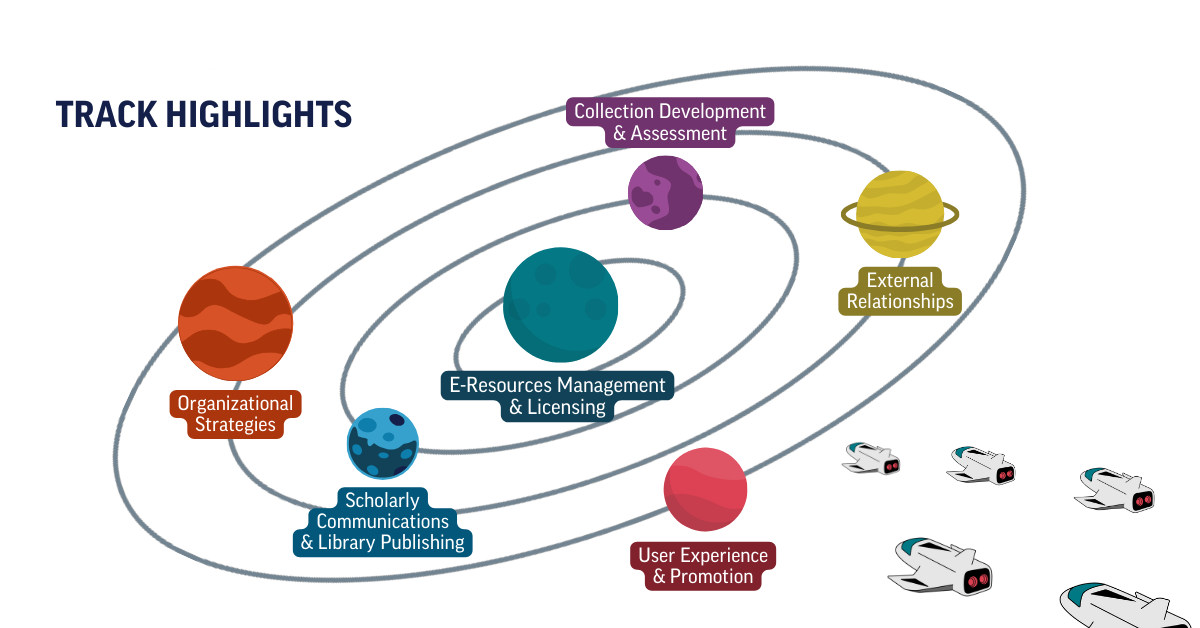
2024 Track Hightlights
Our program planning committees have molded ER&L tracks over the past 19 years. The PPC Track Chairs have prepared the highlights within each of their tracks.
1. E-Resources Management & Licensing
Navigate the evolving landscape of E-Resources Management & Licensing with 30+ captivating sessions! We’re excited to learn and grow with you as you take your expertise to the next level. Explore the world of FOLIO, a next-gen integrated library system. Examine how consortia are adopting it, discover training opportunities, and pick up some tips for migration. Evaluate some non-library tools like AirTable, ClickUp, and PowerBI to streamline holdings management, invoice processing, and usage analysis. Take a closer look at Alma functionalities through dedicated sessions on migration, eBook management, automation, and incorporating license information. Dive into content platform accessibility with practical tips on collecting necessary documentation and conducting reviews and audits. Tackle troubleshooting like a pro after learning workflows, tips, and tricks from your colleagues. Be ready for product migrations with a look at valuable pivoting skills and what it’s like to switch resource sharing systems. Consider different ERM options with sessions on syncing multiple knowledge bases, creating an information hub, and managing with a small staff. Investigate the benefits and updated recommendations for KBART in holdings automation. Hone your negotiating skills with presentations covering negotiation principles, ethics clauses, alumni access, and early-career insights – it’s not just about the numbers!
TRACK CHAIR:
Erin Finnerty
Electronic Resources Librarian
Temple University
2. Collection Development & Assessment
Data-driven approaches to collection management continue to be a strong trend again this year. We will hear about assessment using automated methods for gathering data, from COUNTER standard to title lists (e.g., SUSHI, APIs, AI); different tools for visualization, data management, and scripting (e.g., power BI, CC-PLUS, Python); and how to problem solve in your assessment work without any fancy tools. Presenters will share their methods for performing assessment across different vendor platforms using aggregated usage data and for different formats, including for streaming video. Evidence-based acquisition (EBA) and approval plans for books: managing them and assessing them are again on the radar this year. Evergreen topics like cancellations, cost savings, and resilience are also on the schedule, along with discussions of assessing for accessibility (VPATs, WCAG, etc).
TRACK CHAIRS:
Jaclyn McLean
Electronic Resources Librarian
University of Saskatchewan
Kavita Mundle
Clinical Associate Professor, Head of Resource Acquisitions and Management
University of Illinois at Chicago
3. Organizational Strategies
TBD
TRACK CHAIR:
Kate Hill
Library Services Engineer
EBSCO Information Systems
4. External Relationships
External relationships are crucial for library success. They can help us gain a better understanding of the issues we are facing and often from different perspectives. Ideally, they also help us collectively manage and create solutions. Come join us for timely discussions about the embrace of artificial intelligence (AI) in the classroom and how to protect your library from cybercrime. Then be sure to check out the sessions where you will learn more about breaking down barriers to scholarly publishing whether through targeted communication to authors or by managing and standardizing metadata for better coordination and accessibility.
TRACK CHAIR:
Julie L. Glascock
Director of Acquisitions and Eresources
Vanderbilt University
5. User Experience & Promotion
The User Experience and Promotion track offers three posters, a workshop, and 21 in-person and recorded presentations. You’ll gain valuable insights, techniques, and best practices that will enable you to enhance the experience for your user population.
Start your conference by attending a UX research workshop, learning about testing methodologies, including card sorts and tree tests, and developing unbiased questions that connect the gaps between user intentions and actions.
In addition to the workshop, there are sessions dedicated to usability testing practices, user-centered design techniques, and a distinctive tool designed to assist patrons in navigating physical library spaces. Multiple sessions are geared towards e-resource accessibility, offering guidance on conducting accessibility audits, collaborating with vendors, and advocating for accessibility in the collection management process. Additional sessions concentrate on service assessment, exploring how libraries have analyzed trouble tickets and chat transcripts to enhance customer service. Some sessions delve into marketing and outreach concepts, presenting innovative approaches to promote library resources and providing insights on evaluating the effectiveness of different marketing techniques on resource usage.
Lastly, enjoy posters that showcase projects on improving access to library resources through a review of LibGuide content, LibGuides web accessibility audit, and a marketing art that enhances students’ experience.
TRACK CHAIRS:
Heather Jeffcoat
Web & Discovery Management Librarian
Georgia Tech
Ranti Junus
Systems Librarian, Electronic Resources
Subject librarian for Library Science and Museum Studies
Michigan State University Libraries
6. Scholarly Communications & Library Publishing
Technology continues to change and shape the way we do our daily work. From acquisitions to Open AI (Artificial Intelligence), the Scholarly Communication & Library Publishing track is set to have a series of topics to help us navigate those changes.
For those looking to leverage library resources vs. library budgets, you will find guidance from presentations on Transformative Agreements, Read & Publish workflows, and Open Access Agreements. If you’re looking to work with more Open Access or Open Data resources over the next few years, you will find topics on the state of Open Data, the changing landscape of Open Access, key primary resource open access collections, adapting to publisher trends and vision for Open Access, using Python to analyze Open Access publications and APC’s, and improving the discoverability of Open Access resources. The different topics available in this track do not end here! If you are looking for ways to encourage your faculty to participate in your institutional repository, we have a presentation for you with tips and tricks, as well as a presentation aimed to help advance the repository with author profiles. Several presentations look to improve staff and patron satisfaction by reducing administrative efforts when managing course reserves, using knowledge graphs for analyzing library journal data, engaging with social media, and a review of the launch of Imaging Neuroscience. If you are interested in artificial intelligence (AI), there is a presentation on how to navigate AI within the academic landscape. Additionally, SCELC and CUNY will provide their perspectives on ITHAKA’s infrastructure services. Finally, you will not want to miss a key presentation on how to align your campus Diversity, Equity, and Inclusion (DEI) goals with equitable practices in collections and scholarly communications in your library.
TRACK CHAIR:
Kaci Resau
Electronic Resources Manager
Icahn School of Medicine at Mount Sinai